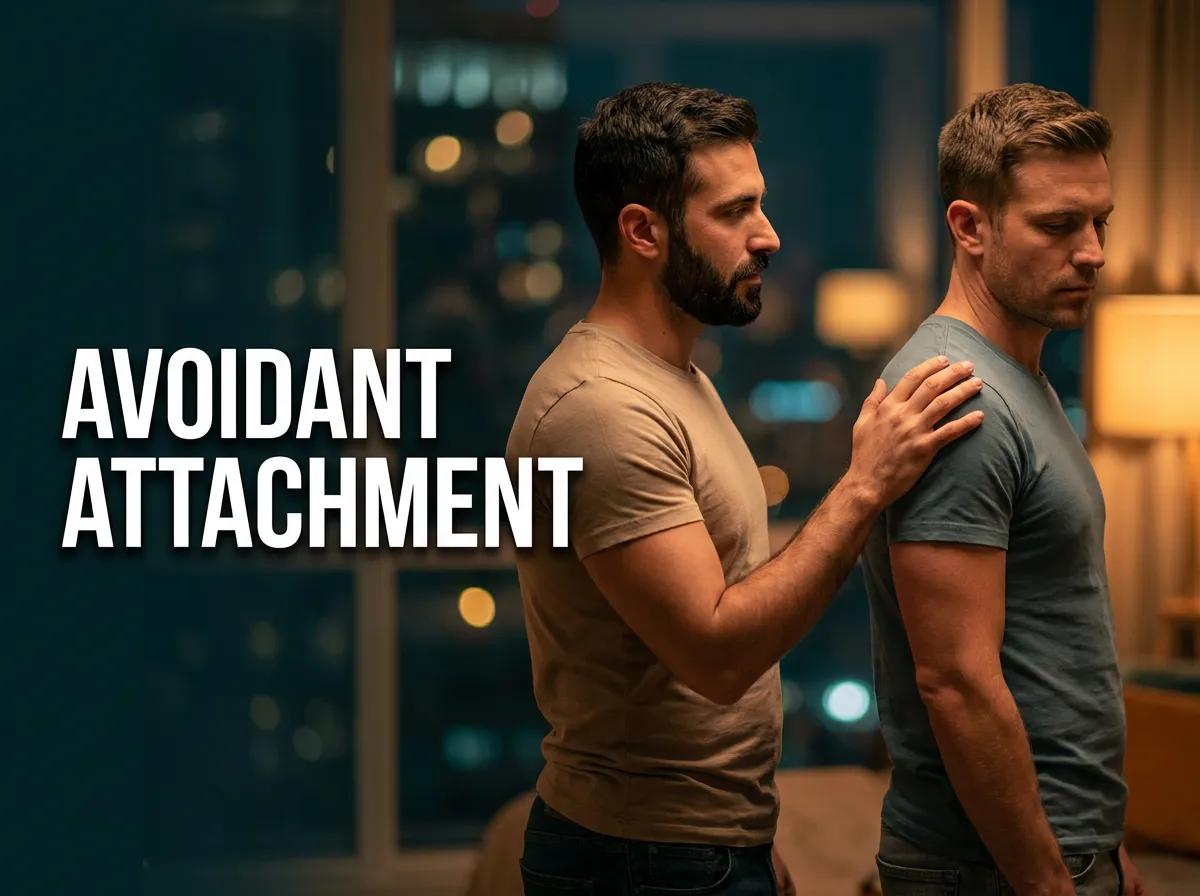
Avoidant Attachment in Gay Dating: Signs + What to Do
If you’ve ever dated a guy who felt amazing at first and then suddenly got “busy,” went quiet, or acted like you were asking for marriage because you wanted a simple check-in text, you’re not alone.
A lot of gay men end up stuck in a painful loop with avoidant attachment. It can look like chemistry, then distance. Intensity, then confusion. You start questioning yourself, your worth, your standards, and sometimes your sanity.
What is avoidant attachment?
Avoidant attachment is a nervous system pattern where closeness starts to feel unsafe. Even if someone likes you, intimacy can trigger them. So they unconsciously create distance to feel in control again.
This does not automatically mean they are a bad person. But it does mean the relationship can become exhausting if nothing changes.
And yes, avoidant attachment can show up in gay dating in very specific ways.
Why avoidant attachment can hit differently for gay men
A lot of gay men learned early that love and safety were conditional. Maybe you had to hide parts of yourself. Maybe affection came with criticism. Maybe you were praised for being “strong” and punished for having needs.
Even if your family was loving, many of us still absorbed a message like:
“If I’m too much, I’ll be rejected.”
So later, closeness can feel like danger, even when it’s healthy.
Avoidant attachment is often not about you. It’s about what closeness represents to their nervous system.
Signs of avoidant attachment in gay dating
Not every avoidant does all of these, but if you’re seeing a consistent pattern, pay attention.
1) He’s consistent until you get closer
Once you define the relationship, talk about feelings, or start seeing each other more regularly, he pulls back.
2) He avoids labels but still wants access to you
He wants the benefits of closeness but not the responsibility of clarity.
3) He gets uncomfortable when you express a need
Even a normal need, like “Can we plan our next date?” can feel like pressure to him.
4) He goes cold after intimacy
This can be emotional intimacy or sexual intimacy. You have a great night, then he disappears for two days.
5) He intellectualizes everything
He talks about feelings like a podcast episode, but struggles to actually be in them with you.
6) He keeps you slightly uncertain
Not always intentionally. But the result is you feel like you are always trying to earn stability.
7) He frames your needs as “too much”
This is a big one. You ask for something reasonable and suddenly you’re “needy” or “dramatic.”
Avoidant vs emotionally unavailable: what’s the difference?
This matters because you already cover emotional unavailability on your blog.
Emotionally unavailable often means they cannot or will not do closeness. Period.
Avoidant attachment can mean they want closeness, but their system panics when it arrives.
In real life, the difference shows up in one question:
Are they willing to work on it, or do they keep repeating the same harm?
If they are curious, accountable, and open to growth, there is hope.
If they blame you, disappear, and refuse repair, you are not in a relationship, you are in a nervous system workout.
If you’re trying to figure out which one you’re dealing with, this breakdown on emotionally unavailable men will help you spot the pattern faster.
The avoidant push pull cycle
Here’s the common cycle:
Connection feels exciting
Closeness increases
Their nervous system reads closeness as threat
They deactivate: distance, silence, criticism, “I need space”
You feel anxious and reach for reassurance
They feel more pressure and pull away more
You feel rejected and start overthinking
They come back when they feel safe again
This is why it can feel addictive. The “return” feels like relief, not love.
If this dynamic feels painfully familiar, you’ll probably relate to this guide on anxious attachment in gay dating and how it shows up when you’re dating someone avoidant.
What to do if you’re dating an avoidant guy
You do not need to become colder to be loved. You need to become clearer.
Step 1: Stop negotiating with mixed signals
If you keep accepting uncertainty, you teach your nervous system that uncertainty is normal.
Try this grounding question:
“Is this connection making me feel more secure over time, or more anxious?”
Step 2: Ask for clarity early (and watch what happens)
Avoidants often do fine with casual vibes. The moment you ask for clarity, their pattern shows itself.
Here are scripts that are calm, not intense:
“I like you and I’m enjoying this. What are you looking for right now?”
“I’m not asking for a big promise. I just want to know if we’re building something or keeping it casual.”
“Consistency matters to me. Are you open to something steady?”
If he responds with respect, great.
If he dodges, jokes, or turns it into “why are you pressuring me,” that’s information.
Step 3: Set a boundary that protects your dignity
Boundaries are not punishments. They are clarity.
Examples:
“I’m happy to keep seeing you, but I’m not available for hot and cold.”
“If you need space, that’s okay. I just need a clear timeframe and a plan to reconnect.”
“I don’t do disappearing. If you’re overwhelmed, tell me. Silence doesn’t work for me.”
Step 4: Watch for repair, not apologies
Avoidant patterns can improve when someone learns to repair. Repair looks like:
They acknowledge impact
They communicate before disappearing
They follow through on what they say
They don’t shame you for having needs
A simple “sorry” followed by the same behavior is not repair. It’s a reset button.
Step 5: Don’t let your anxious side run the relationship
Even if you are not “anxious attachment,” anyone can become anxious with an avoidant partner.
If you feel yourself spiraling, do this mini reset:
Put your phone down for 10 minutes
Breathe slowly and name what’s happening: “My body is in threat mode”
Ask: “What do I actually need right now?”
Choose one action that supports you: walk, journal, voice note a friend, eat something
Then respond from self respect, not panic
If you think you are the avoidant one
If you’re reading this and thinking, “Oh. I do this,” you’re not broken. You’re patterned.
Try these small shifts:
Practice saying one feeling out loud, even if it’s awkward: “I feel overwhelmed, but I still like you.”
Replace disappearing with a clean message: “I need a day to reset. Can we talk tomorrow?”
Notice your deactivation stories: “He’s too needy,” “This is moving too fast,” “I’m not ready.” Ask: is it true, or is it fear?
Avoidant attachment can heal, but it usually requires nervous system work, not just insight.
When to walk away
You should seriously consider stepping back if:
He repeatedly disappears and calls it “space”
He mocks your needs or calls you too much
You feel anxious more days than you feel calm
You are doing all the emotional labor
He refuses accountability or support
You can have compassion for someone’s wounds and still choose yourself.
A quick reminder for your heart
You are not “too much” for wanting consistency.
You are not needy for wanting clarity.
And you are not asking for the moon when you ask a man to communicate like an adult.
If you keep choosing people who pull away when it gets real, it might be time to stop asking, “How do I make him stay?” and start asking, “Why do I keep abandoning myself?”
If you want support breaking this pattern at the root, that’s exactly the kind of work I do inside Radiant Hearts Transformation.
If you want support with that, you can book a free clarity call here: https://www.rainbowjourney.co/book-a-call


